About the course
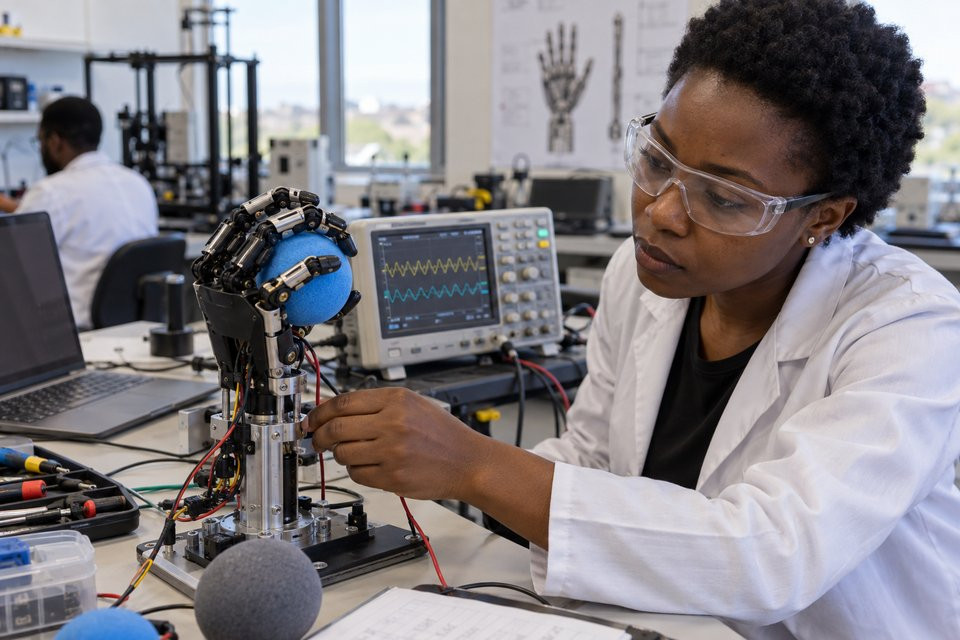
Explore how engineering methods contribute to the understanding and improvement of healthcare technology. The proposed outline links electronics, computing and measurement with biological systems. Projects should address defined health-service needs in Southern Africa and consider equipment reliability, usability, maintenance and the quality of evidence before any clinical application.
What you'll learn
- Explain relationships between biological systems and engineering models.
- Interpret biomedical signals or measurement data with stated uncertainty.
- Compare device concepts against a defined technical and user requirement.
- Prepare a documented investigation which considers safety and ethical constraints.
Requirements
- Entry requires A Level STEM subjects or a National Diploma in a relevant health or science field. English Language is required. Clinical placement and professional-registration rules also apply. A relevant National Diploma may support second-year entry where BMIT approves module equivalence and professional rules permit. Advanced entry is not automatic.
- African Kalanga is a compulsory graduation subject in every year of this programme. BMIT confirms the approved entry route, any recognition of prior learning and access to required practical facilities before enrolment.
Course content
Subjects in this programme
The subjects are grouped by learning stage, from foundations to specialist study and supervised application. Complete earlier foundations before the related advanced work. Clinical, laboratory, field and workplace subjects use approved facilities and supervision appropriate to the programme.
33 subjects are listed below, with a short description of each. The Subject descriptions tab contains the learning outcomes, topics, practical tasks and assessments.
Stage 1: Science and mathematics
- Differential Calculus. Examine functions, limits and their relationship within differential calculus. The subject develops differentiation and rates of change, then examines optimisation and model assumptions. Analyse a measured change and compare graphical and algebraic solutions.
- Integral Calculus and Differential Equations. Develop your understanding of integral calculus and differential equations through integration and accumulated quantities. The subject develops first-order equations and second-order equations, then examines initial conditions and numerical checks. Model a simple accumulation process and check the solution against a numerical estimate.
- Linear Algebra. Study vectors and matrices as foundations for linear algebra. The subject develops linear systems and eigenvalues, then examines transformations and computational verification. Solve a small system using manual reasoning and a computational check.
- Mechanics and General Physics. Examine motion, forces and their relationship within mechanics and general physics. The subject develops energy and momentum, then examines oscillations and measurement uncertainty. Use a supervised teaching experiment to compare observation with a physical model.
- Electricity, Magnetism and Waves. Develop your understanding of electricity, magnetism and waves through electric fields and magnetic fields. The subject develops electromagnetic induction and wave behaviour, then examines optical principles and physical models. Interpret measurements from supervised electrical or optical teaching equipment.
- General Chemistry. Study atomic structure and bonding as foundations for general chemistry. The subject develops chemical quantities and solutions, then examines equilibrium and acids and bases. Analyse low-risk teaching data and complete approved laboratory exercises.
- Cell Biology. Examine cell structures, membranes and their relationship within cell biology. The subject develops organelles and cell division, then examines cell signalling and microscopy concepts. Interpret approved cell images and low-risk teaching observations.
- Academic and Professional Communication. Develop your understanding of academic and professional communication through reading strategies and evidence use. The subject develops report structure and presentations, then examines audience and referencing. Prepare a report and presentation for a defined professional audience.
Stage 2: Biological and electronic systems
- Human Anatomy. Study body organisation and musculoskeletal structures as foundations for human anatomy. The subject develops thoracic structures and abdominal structures, then examines nervous structures and anatomical relationships. Study approved anatomical models and images in a supervised setting.
- Human Physiology. Examine homeostasis, cardiovascular function and their relationship within human physiology. The subject develops respiration and renal function, then examines endocrine regulation and nervous function. Interpret physiological teaching data and supervised non-invasive demonstrations.
- Biochemistry. Develop your understanding of biochemistry through biomolecules and enzymes. The subject develops metabolism and energy transfer, then examines regulation and biochemical evidence. Interpret approved biochemical teaching data.
- Biophysics. Study biological forces and diffusion as foundations for biophysics. The subject develops membranes and optical methods, then examines electrical phenomena and measurement models. Analyse a non-clinical biological measurement using safe teaching data.
- Circuit Analysis. Examine circuit quantities, network laws and their relationship within circuit analysis. The subject develops resistive circuits and transients, then examines alternating-current circuits and measurement. Analyse and test low-voltage teaching circuits under supervision.
- Analogue Electronics. Develop your understanding of analogue electronics through semiconductor behaviour and amplifiers. The subject develops filters and feedback, then examines power supplies and signal quality. Evaluate a current-limited teaching circuit and explain observed signal changes.
- Digital Electronics. Study binary representation and logic gates as foundations for digital electronics. The subject develops combinational circuits and sequential circuits, then examines timing and digital interfaces. Implement a small logic function using simulation or approved low-voltage equipment.
- Programming Fundamentals. Examine variables, control flow and their relationship within programming fundamentals. The subject develops functions and data structures, then examines file handling and testing. Develop a small program which processes a defined teaching dataset.
Stage 3: Biomedical engineering
- Signals and Systems. Develop your understanding of signals and systems through signal representation and linear systems. The subject develops time response and frequency response, then examines sampling and filtering. Analyse recorded signals and compare alternative processing choices.
- Embedded Systems. Study microcontroller architecture and input and output as foundations for embedded systems. The subject develops timing and interrupts, then examines embedded programming and interface testing. Develop a low-voltage sensor application in an approved teaching environment.
- Measurement and Instrumentation. Examine sensors, signal conditioning and their relationship within measurement and instrumentation. The subject develops calibration and data acquisition, then examines traceability and measurement uncertainty. Compare instruments using approved references and retain a calibration record.
- Biomedical Transport Phenomena. Develop your understanding of biomedical transport phenomena through diffusion and fluid transport. The subject develops membrane transport and heat transport, then examines physiological models and model limitations. Evaluate simplified biological transport models using public teaching data.
- Biomedical Signals and Control. Study physiological signals and measurement artefacts as foundations for biomedical signals and control. The subject develops signal analysis and system models, then examines feedback concepts and validation. Analyse approved non-identifiable biomedical recordings.
- Biomedical Instrumentation. Examine clinical requirements, sensor interfaces and their relationship within biomedical instrumentation. The subject develops instrument functions and measurement quality, then examines usability and device safety. Evaluate a safe non-clinical teaching device under engineering supervision.
- Diagnostic Imaging Physics. Develop your understanding of diagnostic imaging physics through radiation interactions and image formation. The subject develops equipment principles and digital imaging, then examines image quality and protection. Interpret approved teaching images and supervised equipment demonstrations.
- Applied Statistics. Study descriptive measures and probability as foundations for applied statistics. The subject develops sampling and estimation, then examines hypothesis testing and regression. Analyse an approved dataset and distinguish uncertainty from systematic bias.
Stage 4: Research and professional integration
- Healthcare Technology Management. Examine equipment inventories, maintenance and their relationship within healthcare technology management. The subject develops procurement and user training, then examines incident reporting and lifecycle planning. Review an authorised equipment-management case.
- Health Ethics and Professional Practice. Develop your understanding of health ethics and professional practice through consent and confidentiality. The subject develops scope of practice and equity, then examines professional accountability and ethical reasoning. Discuss a simulated ethical dilemma with attention to patient rights.
- Engineering Design Methods. Study problem definition and requirements as foundations for engineering design methods. The subject develops concept comparison and constraints, then examines verification planning and design review. Develop and review alternatives for a defined civilian technical need.
- Research Methods. Examine research questions, literature review and their relationship within research methods. The subject develops study design and data collection, then examines ethics and interpretation. Prepare a feasible investigation proposal with a defined evidence need.
- Project Development and Feasibility. Develop your understanding of project development and feasibility through problem definition and evidence review. The subject develops requirements and method selection, then examines feasibility and evaluation criteria. Develop an approved discipline-specific project proposal with a supervisor.
- Integrated Project and Technical Report. Study implementation and evidence collection as foundations for integrated project and technical report. The subject develops analysis and verification, then examines limitations and communication. Complete the approved project and maintain an auditable evidence record.
African History and Pan Africanism
- African History and Pan Africanism 101 (Level 1, compulsory core module): Study African history through oral, written and archaeological evidence. Examine the diversity of African societies, knowledge and exchange, then trace the emergence of Pan African ideas about identity, solidarity and self-determination.
- African History and Pan Africanism 201 (Level 2, compulsory core module): Examine colonial change, resistance and liberation across Africa, with attention to Zimbabwe and South Africa. Compare Pan African movements, organisations and debates, including contributions from women, workers and diaspora communities.
- African History and Pan Africanism 301 (Level 3, compulsory core module): Evaluate the legacy of Pan Africanism in continental and regional cooperation, culture and public life. Apply historical inquiry to a heritage, community or professional issue, recognising both achievements and contested interpretations.
Assessment and practical learning
- Proposed assessment: mathematical problem sets and technical reports with calculations, units, assumptions and limitations made explicit.
- Supervised laboratory or workshop tasks assessed through observation, evidence records and an individual explanation of results.
- An integrated design or investigation portfolio, presentation and written assessment. BMIT must approve weighting and progression rules.
Practical application
Learners need supervised engineering laboratories and access to safe teaching equipment. Device work should begin with simulation and non-clinical evaluation. Human-participant or clinical testing requires independent ethical and regulatory approval. This outline does not confer professional engineering or healthcare registration.
African History and Pan Africanism practical learning
- African History and Pan Africanism 101: Create an annotated timeline or digital learning poster on a selected African society or historical development. Compare at least two credible sources and explain one connection with your field of study.
- African History and Pan Africanism 201: Develop a comparative case study of a liberation issue or Pan African debate relevant to Southern Africa. Use a historical document alongside a scholarly account and explain differences in purpose and interpretation.
- African History and Pan Africanism 301: Prepare a sourced heritage or civic-learning project connected with your field or a Southern African community. Explain its historical basis, audience, permission needs and limits. Obtain consent if you conduct interviews.
Subject descriptions
Each subject below includes its purpose, learning outcomes, main topics, practical task and assessment approach.
Differential Calculus
Stage 1: Science and mathematics
Examine functions, limits and their relationship within differential calculus. The subject develops differentiation and rates of change, then examines optimisation and model assumptions. Analyse a measured change and compare graphical and algebraic solutions.
Learning outcomes
- Explain functions and limits using an appropriate example.
- Analyse a subject-related problem involving differentiation and rates of change.
- Present reasoned evidence addressing optimisation and model assumptions.
Main topics
- Functions
- Limits
- Differentiation
- Rates of change
- Optimisation
- Model assumptions
Practical task
Analyse a measured change and compare graphical and algebraic solutions.
Assessment
Submit worked problems and a short interpretation of an optimisation case.
Integral Calculus and Differential Equations
Stage 1: Science and mathematics
Develop your understanding of integral calculus and differential equations through integration and accumulated quantities. The subject develops first-order equations and second-order equations, then examines initial conditions and numerical checks. Model a simple accumulation process and check the solution against a numerical estimate.
Learning outcomes
- Explain integration and accumulated quantities using an appropriate example.
- Analyse a subject-related problem involving first-order equations and second-order equations.
- Present reasoned evidence addressing initial conditions and numerical checks.
Main topics
- Integration
- Accumulated quantities
- First-order equations
- Second-order equations
- Initial conditions
- Numerical checks
Practical task
Model a simple accumulation process and check the solution against a numerical estimate.
Assessment
Complete an analytical assignment explaining initial conditions and solution limits.
Linear Algebra
Stage 1: Science and mathematics
Study vectors and matrices as foundations for linear algebra. The subject develops linear systems and eigenvalues, then examines transformations and computational verification. Solve a small system using manual reasoning and a computational check.
Learning outcomes
- Explain vectors and matrices using an appropriate example.
- Analyse a subject-related problem involving linear systems and eigenvalues.
- Present reasoned evidence addressing transformations and computational verification.
Main topics
- Vectors
- Matrices
- Linear systems
- Eigenvalues
- Transformations
- Computational verification
Practical task
Solve a small system using manual reasoning and a computational check.
Assessment
Submit calculations and an explanation of the meaning of the solution.
Mechanics and General Physics
Stage 1: Science and mathematics
Examine motion, forces and their relationship within mechanics and general physics. The subject develops energy and momentum, then examines oscillations and measurement uncertainty. Use a supervised teaching experiment to compare observation with a physical model.
Learning outcomes
- Explain motion and forces using an appropriate example.
- Analyse a subject-related problem involving energy and momentum.
- Present reasoned evidence addressing oscillations and measurement uncertainty.
Main topics
- Motion
- Forces
- Energy
- Momentum
- Oscillations
- Measurement uncertainty
Practical task
Use a supervised teaching experiment to compare observation with a physical model.
Assessment
Submit a laboratory report and quantitative problem set.
Electricity, Magnetism and Waves
Stage 1: Science and mathematics
Develop your understanding of electricity, magnetism and waves through electric fields and magnetic fields. The subject develops electromagnetic induction and wave behaviour, then examines optical principles and physical models. Interpret measurements from supervised electrical or optical teaching equipment.
Learning outcomes
- Explain electric fields and magnetic fields using an appropriate example.
- Analyse a subject-related problem involving electromagnetic induction and wave behaviour.
- Present reasoned evidence addressing optical principles and physical models.
Main topics
- Electric fields
- Magnetic fields
- Electromagnetic induction
- Wave behaviour
- Optical principles
- Physical models
Practical task
Interpret measurements from supervised electrical or optical teaching equipment.
Assessment
Complete calculations and a report explaining discrepancies from theory.
General Chemistry
Stage 1: Science and mathematics
Study atomic structure and bonding as foundations for general chemistry. The subject develops chemical quantities and solutions, then examines equilibrium and acids and bases. Analyse low-risk teaching data and complete approved laboratory exercises.
Learning outcomes
- Explain atomic structure and bonding using an appropriate example.
- Analyse a subject-related problem involving chemical quantities and solutions.
- Present reasoned evidence addressing equilibrium and acids and bases.
Main topics
- Atomic structure
- Bonding
- Chemical quantities
- Solutions
- Equilibrium
- Acids and bases
Practical task
Analyse low-risk teaching data and complete approved laboratory exercises.
Assessment
Submit a practical record and calculations with units and assumptions.
Cell Biology
Stage 1: Science and mathematics
Examine cell structures, membranes and their relationship within cell biology. The subject develops organelles and cell division, then examines cell signalling and microscopy concepts. Interpret approved cell images and low-risk teaching observations.
Learning outcomes
- Explain cell structures and membranes using an appropriate example.
- Analyse a subject-related problem involving organelles and cell division.
- Present reasoned evidence addressing cell signalling and microscopy concepts.
Main topics
- Cell structures
- Membranes
- Organelles
- Cell division
- Cell signalling
- Microscopy concepts
Practical task
Interpret approved cell images and low-risk teaching observations.
Assessment
Submit an annotated cell-analysis portfolio.
Academic and Professional Communication
Stage 1: Science and mathematics
Develop your understanding of academic and professional communication through reading strategies and evidence use. The subject develops report structure and presentations, then examines audience and referencing. Prepare a report and presentation for a defined professional audience.
Learning outcomes
- Explain reading strategies and evidence use using an appropriate example.
- Analyse a subject-related problem involving report structure and presentations.
- Present reasoned evidence addressing audience and referencing.
Main topics
- Reading strategies
- Evidence use
- Report structure
- Presentations
- Audience
- Referencing
Practical task
Prepare a report and presentation for a defined professional audience.
Assessment
Submit revised written work and an individual presentation.
Human Anatomy
Stage 2: Biological and electronic systems
Study body organisation and musculoskeletal structures as foundations for human anatomy. The subject develops thoracic structures and abdominal structures, then examines nervous structures and anatomical relationships. Study approved anatomical models and images in a supervised setting.
Learning outcomes
- Explain body organisation and musculoskeletal structures using an appropriate example.
- Analyse a subject-related problem involving thoracic structures and abdominal structures.
- Present reasoned evidence addressing nervous structures and anatomical relationships.
Main topics
- Body organisation
- Musculoskeletal structures
- Thoracic structures
- Abdominal structures
- Nervous structures
- Anatomical relationships
Practical task
Study approved anatomical models and images in a supervised setting.
Assessment
Submit an annotated anatomy portfolio and identification assessment.
Human Physiology
Stage 2: Biological and electronic systems
Examine homeostasis, cardiovascular function and their relationship within human physiology. The subject develops respiration and renal function, then examines endocrine regulation and nervous function. Interpret physiological teaching data and supervised non-invasive demonstrations.
Learning outcomes
- Explain homeostasis and cardiovascular function using an appropriate example.
- Analyse a subject-related problem involving respiration and renal function.
- Present reasoned evidence addressing endocrine regulation and nervous function.
Main topics
- Homeostasis
- Cardiovascular function
- Respiration
- Renal function
- Endocrine regulation
- Nervous function
Practical task
Interpret physiological teaching data and supervised non-invasive demonstrations.
Assessment
Submit a function-based case analysis and data interpretation.
Biochemistry
Stage 2: Biological and electronic systems
Develop your understanding of biochemistry through biomolecules and enzymes. The subject develops metabolism and energy transfer, then examines regulation and biochemical evidence. Interpret approved biochemical teaching data.
Learning outcomes
- Explain biomolecules and enzymes using an appropriate example.
- Analyse a subject-related problem involving metabolism and energy transfer.
- Present reasoned evidence addressing regulation and biochemical evidence.
Main topics
- Biomolecules
- Enzymes
- Metabolism
- Energy transfer
- Regulation
- Biochemical evidence
Practical task
Interpret approved biochemical teaching data.
Assessment
Submit pathway reasoning and a data-analysis report.
Biophysics
Stage 2: Biological and electronic systems
Study biological forces and diffusion as foundations for biophysics. The subject develops membranes and optical methods, then examines electrical phenomena and measurement models. Analyse a non-clinical biological measurement using safe teaching data.
Learning outcomes
- Explain biological forces and diffusion using an appropriate example.
- Analyse a subject-related problem involving membranes and optical methods.
- Present reasoned evidence addressing electrical phenomena and measurement models.
Main topics
- Biological forces
- Diffusion
- Membranes
- Optical methods
- Electrical phenomena
- Measurement models
Practical task
Analyse a non-clinical biological measurement using safe teaching data.
Assessment
Submit a model and uncertainty-aware report.
Circuit Analysis
Stage 2: Biological and electronic systems
Examine circuit quantities, network laws and their relationship within circuit analysis. The subject develops resistive circuits and transients, then examines alternating-current circuits and measurement. Analyse and test low-voltage teaching circuits under supervision.
Learning outcomes
- Explain circuit quantities and network laws using an appropriate example.
- Analyse a subject-related problem involving resistive circuits and transients.
- Present reasoned evidence addressing alternating-current circuits and measurement.
Main topics
- Circuit quantities
- Network laws
- Resistive circuits
- Transients
- Alternating-current circuits
- Measurement
Practical task
Analyse and test low-voltage teaching circuits under supervision.
Assessment
Submit circuit calculations and a measured-results record.
Analogue Electronics
Stage 2: Biological and electronic systems
Develop your understanding of analogue electronics through semiconductor behaviour and amplifiers. The subject develops filters and feedback, then examines power supplies and signal quality. Evaluate a current-limited teaching circuit and explain observed signal changes.
Learning outcomes
- Explain semiconductor behaviour and amplifiers using an appropriate example.
- Analyse a subject-related problem involving filters and feedback.
- Present reasoned evidence addressing power supplies and signal quality.
Main topics
- Semiconductor behaviour
- Amplifiers
- Filters
- Feedback
- Power supplies
- Signal quality
Practical task
Evaluate a current-limited teaching circuit and explain observed signal changes.
Assessment
Submit a circuit report with test evidence.
Digital Electronics
Stage 2: Biological and electronic systems
Study binary representation and logic gates as foundations for digital electronics. The subject develops combinational circuits and sequential circuits, then examines timing and digital interfaces. Implement a small logic function using simulation or approved low-voltage equipment.
Learning outcomes
- Explain binary representation and logic gates using an appropriate example.
- Analyse a subject-related problem involving combinational circuits and sequential circuits.
- Present reasoned evidence addressing timing and digital interfaces.
Main topics
- Binary representation
- Logic gates
- Combinational circuits
- Sequential circuits
- Timing
- Digital interfaces
Practical task
Implement a small logic function using simulation or approved low-voltage equipment.
Assessment
Submit a logic design, test cases and timing analysis.
Programming Fundamentals
Stage 2: Biological and electronic systems
Examine variables, control flow and their relationship within programming fundamentals. The subject develops functions and data structures, then examines file handling and testing. Develop a small program which processes a defined teaching dataset.
Learning outcomes
- Explain variables and control flow using an appropriate example.
- Analyse a subject-related problem involving functions and data structures.
- Present reasoned evidence addressing file handling and testing.
Main topics
- Variables
- Control flow
- Functions
- Data structures
- File handling
- Testing
Practical task
Develop a small program which processes a defined teaching dataset.
Assessment
Submit working code, tests and a concise user explanation.
Signals and Systems
Stage 3: Biomedical engineering
Develop your understanding of signals and systems through signal representation and linear systems. The subject develops time response and frequency response, then examines sampling and filtering. Analyse recorded signals and compare alternative processing choices.
Learning outcomes
- Explain signal representation and linear systems using an appropriate example.
- Analyse a subject-related problem involving time response and frequency response.
- Present reasoned evidence addressing sampling and filtering.
Main topics
- Signal representation
- Linear systems
- Time response
- Frequency response
- Sampling
- Filtering
Practical task
Analyse recorded signals and compare alternative processing choices.
Assessment
Submit a reproducible signal-analysis report.
Embedded Systems
Stage 3: Biomedical engineering
Study microcontroller architecture and input and output as foundations for embedded systems. The subject develops timing and interrupts, then examines embedded programming and interface testing. Develop a low-voltage sensor application in an approved teaching environment.
Learning outcomes
- Explain microcontroller architecture and input and output using an appropriate example.
- Analyse a subject-related problem involving timing and interrupts.
- Present reasoned evidence addressing embedded programming and interface testing.
Main topics
- Microcontroller architecture
- Input and output
- Timing
- Interrupts
- Embedded programming
- Interface testing
Practical task
Develop a low-voltage sensor application in an approved teaching environment.
Assessment
Submit code, interface diagrams and test evidence.
Measurement and Instrumentation
Stage 3: Biomedical engineering
Examine sensors, signal conditioning and their relationship within measurement and instrumentation. The subject develops calibration and data acquisition, then examines traceability and measurement uncertainty. Compare instruments using approved references and retain a calibration record.
Learning outcomes
- Explain sensors and signal conditioning using an appropriate example.
- Analyse a subject-related problem involving calibration and data acquisition.
- Present reasoned evidence addressing traceability and measurement uncertainty.
Main topics
- Sensors
- Signal conditioning
- Calibration
- Data acquisition
- Traceability
- Measurement uncertainty
Practical task
Compare instruments using approved references and retain a calibration record.
Assessment
Submit an uncertainty-aware measurement report.
Biomedical Transport Phenomena
Stage 3: Biomedical engineering
Develop your understanding of biomedical transport phenomena through diffusion and fluid transport. The subject develops membrane transport and heat transport, then examines physiological models and model limitations. Evaluate simplified biological transport models using public teaching data.
Learning outcomes
- Explain diffusion and fluid transport using an appropriate example.
- Analyse a subject-related problem involving membrane transport and heat transport.
- Present reasoned evidence addressing physiological models and model limitations.
Main topics
- Diffusion
- Fluid transport
- Membrane transport
- Heat transport
- Physiological models
- Model limitations
Practical task
Evaluate simplified biological transport models using public teaching data.
Assessment
Submit calculations and an interpretation of model assumptions.
Biomedical Signals and Control
Stage 3: Biomedical engineering
Study physiological signals and measurement artefacts as foundations for biomedical signals and control. The subject develops signal analysis and system models, then examines feedback concepts and validation. Analyse approved non-identifiable biomedical recordings.
Learning outcomes
- Explain physiological signals and measurement artefacts using an appropriate example.
- Analyse a subject-related problem involving signal analysis and system models.
- Present reasoned evidence addressing feedback concepts and validation.
Main topics
- Physiological signals
- Measurement artefacts
- Signal analysis
- System models
- Feedback concepts
- Validation
Practical task
Analyse approved non-identifiable biomedical recordings.
Assessment
Submit a reproducible signal investigation and limitations report.
Biomedical Instrumentation
Stage 3: Biomedical engineering
Examine clinical requirements, sensor interfaces and their relationship within biomedical instrumentation. The subject develops instrument functions and measurement quality, then examines usability and device safety. Evaluate a safe non-clinical teaching device under engineering supervision.
Learning outcomes
- Explain clinical requirements and sensor interfaces using an appropriate example.
- Analyse a subject-related problem involving instrument functions and measurement quality.
- Present reasoned evidence addressing usability and device safety.
Main topics
- Clinical requirements
- Sensor interfaces
- Instrument functions
- Measurement quality
- Usability
- Device safety
Practical task
Evaluate a safe non-clinical teaching device under engineering supervision.
Assessment
Submit a device-evaluation report without clinical deployment.
Diagnostic Imaging Physics
Stage 3: Biomedical engineering
Develop your understanding of diagnostic imaging physics through radiation interactions and image formation. The subject develops equipment principles and digital imaging, then examines image quality and protection. Interpret approved teaching images and supervised equipment demonstrations.
Learning outcomes
- Explain radiation interactions and image formation using an appropriate example.
- Analyse a subject-related problem involving equipment principles and digital imaging.
- Present reasoned evidence addressing image quality and protection.
Main topics
- Radiation interactions
- Image formation
- Equipment principles
- Digital imaging
- Image quality
- Protection
Practical task
Interpret approved teaching images and supervised equipment demonstrations.
Assessment
Submit an image-physics and quality-analysis portfolio.
Applied Statistics
Stage 3: Biomedical engineering
Study descriptive measures and probability as foundations for applied statistics. The subject develops sampling and estimation, then examines hypothesis testing and regression. Analyse an approved dataset and distinguish uncertainty from systematic bias.
Learning outcomes
- Explain descriptive measures and probability using an appropriate example.
- Analyse a subject-related problem involving sampling and estimation.
- Present reasoned evidence addressing hypothesis testing and regression.
Main topics
- Descriptive measures
- Probability
- Sampling
- Estimation
- Hypothesis testing
- Regression
Practical task
Analyse an approved dataset and distinguish uncertainty from systematic bias.
Assessment
Submit a reproducible analysis with justified methods and interpretation.
Healthcare Technology Management
Stage 4: Research and professional integration
Examine equipment inventories, maintenance and their relationship within healthcare technology management. The subject develops procurement and user training, then examines incident reporting and lifecycle planning. Review an authorised equipment-management case.
Learning outcomes
- Explain equipment inventories and maintenance using an appropriate example.
- Analyse a subject-related problem involving procurement and user training.
- Present reasoned evidence addressing incident reporting and lifecycle planning.
Main topics
- Equipment inventories
- Maintenance
- Procurement
- User training
- Incident reporting
- Lifecycle planning
Practical task
Review an authorised equipment-management case.
Assessment
Submit a maintenance and service-support improvement proposal.
Health Ethics and Professional Practice
Stage 4: Research and professional integration
Develop your understanding of health ethics and professional practice through consent and confidentiality. The subject develops scope of practice and equity, then examines professional accountability and ethical reasoning. Discuss a simulated ethical dilemma with attention to patient rights.
Learning outcomes
- Explain consent and confidentiality using an appropriate example.
- Analyse a subject-related problem involving scope of practice and equity.
- Present reasoned evidence addressing professional accountability and ethical reasoning.
Main topics
- Consent
- Confidentiality
- Scope of practice
- Equity
- Professional accountability
- Ethical reasoning
Practical task
Discuss a simulated ethical dilemma with attention to patient rights.
Assessment
Submit a justified ethical decision and professional reflection.
Engineering Design Methods
Stage 4: Research and professional integration
Study problem definition and requirements as foundations for engineering design methods. The subject develops concept comparison and constraints, then examines verification planning and design review. Develop and review alternatives for a defined civilian technical need.
Learning outcomes
- Explain problem definition and requirements using an appropriate example.
- Analyse a subject-related problem involving concept comparison and constraints.
- Present reasoned evidence addressing verification planning and design review.
Main topics
- Problem definition
- Requirements
- Concept comparison
- Constraints
- Verification planning
- Design review
Practical task
Develop and review alternatives for a defined civilian technical need.
Assessment
Submit a requirements-led design dossier with review responses.
Research Methods
Stage 4: Research and professional integration
Examine research questions, literature review and their relationship within research methods. The subject develops study design and data collection, then examines ethics and interpretation. Prepare a feasible investigation proposal with a defined evidence need.
Learning outcomes
- Explain research questions and literature review using an appropriate example.
- Analyse a subject-related problem involving study design and data collection.
- Present reasoned evidence addressing ethics and interpretation.
Main topics
- Research questions
- Literature review
- Study design
- Data collection
- Ethics
- Interpretation
Practical task
Prepare a feasible investigation proposal with a defined evidence need.
Assessment
Submit a proposal, methods rationale and ethics considerations.
Project Development and Feasibility
Stage 4: Research and professional integration
Develop your understanding of project development and feasibility through problem definition and evidence review. The subject develops requirements and method selection, then examines feasibility and evaluation criteria. Develop an approved discipline-specific project proposal with a supervisor.
Learning outcomes
- Explain problem definition and evidence review using an appropriate example.
- Analyse a subject-related problem involving requirements and method selection.
- Present reasoned evidence addressing feasibility and evaluation criteria.
Main topics
- Problem definition
- Evidence review
- Requirements
- Method selection
- Feasibility
- Evaluation criteria
Practical task
Develop an approved discipline-specific project proposal with a supervisor.
Assessment
Submit a proposal, evidence review and evaluation plan.
Integrated Project and Technical Report
Stage 4: Research and professional integration
Study implementation and evidence collection as foundations for integrated project and technical report. The subject develops analysis and verification, then examines limitations and communication. Complete the approved project and maintain an auditable evidence record.
Learning outcomes
- Explain implementation and evidence collection using an appropriate example.
- Analyse a subject-related problem involving analysis and verification.
- Present reasoned evidence addressing limitations and communication.
Main topics
- Implementation
- Evidence collection
- Analysis
- Verification
- Limitations
- Communication
Practical task
Complete the approved project and maintain an auditable evidence record.
Assessment
Submit the final project, report and individual oral defence.
African History and Pan Africanism 101
Compulsory core module · Level 1
Study African history through oral, written and archaeological evidence. Examine the diversity of African societies, knowledge and exchange, then trace the emergence of Pan African ideas about identity, solidarity and self-determination.
Learning outcomes
- Place selected African societies and events within a supported historical timeline.
- Compare historical sources and identify perspective, evidence and uncertainty.
- Explain the foundations of Pan Africanism and the contributions of Africans and the diaspora.
Main topics
- Historical inquiry, chronology, oral traditions and source evaluation
- African civilisations, states, trade, livelihoods and knowledge systems
- Southern African history, including Mapungubgwe and Great Zimbabwe
- Slavery, the African diaspora and changing ideas about identity
- Origins of Pan Africanism, solidarity, self-determination and cultural expression
Practical task
Create an annotated timeline or digital learning poster on a selected African society or historical development. Compare at least two credible sources and explain one connection with your field of study.
Assessment
Submit the timeline or poster, an annotated source list and a short explanation of the evidence. Assessment considers chronology, historical accuracy, source judgement and the clarity of your interpretation.
Learning resources
African History and Pan Africanism 201
Compulsory core module · Level 2
Examine colonial change, resistance and liberation across Africa, with attention to Zimbabwe and South Africa. Compare Pan African movements, organisations and debates, including contributions from women, workers and diaspora communities.
Learning outcomes
- Analyse the effects of colonial rule on land, labour, institutions and social relations.
- Compare liberation movements and Pan African arguments using contextual evidence.
- Explain how different groups shaped independence, solidarity and debates about freedom.
Main topics
- Colonial rule, land, labour, education and forms of resistance
- Nationalism, liberation and the end of colonial rule and apartheid
- Pan African congresses, organisations and contrasting interpretations
- Women, labour movements and diaspora participation
- The Organisation of African Unity and debates about unity, sovereignty and development
Practical task
Develop a comparative case study of a liberation issue or Pan African debate relevant to Southern Africa. Use a historical document alongside a scholarly account and explain differences in purpose and interpretation.
Assessment
Submit the case study, a source comparison and a reflection on your conclusions. Assessment considers context, evidence, recognition of different perspectives and the quality of your argument.
Learning resources
African History and Pan Africanism 301
Compulsory core module · Level 3
Evaluate the legacy of Pan Africanism in continental and regional cooperation, culture and public life. Apply historical inquiry to a heritage, community or professional issue, recognising both achievements and contested interpretations.
Learning outcomes
- Evaluate continuity and change from the Organisation of African Unity to the African Union.
- Assess a contemporary Pan African issue using historical evidence and contrasting views.
- Develop an ethical, well-sourced project connecting African history with your field or community.
Main topics
- The African Union, regional cooperation and Southern African integration
- Agenda 2063, development and debates about continental priorities
- Citizenship, migration, diaspora connections and cultural exchange
- African knowledge, heritage, public history and contested narratives
- Research ethics, source attribution and evaluation of a community or professional project
Practical task
Prepare a sourced heritage or civic-learning project connected with your field or a Southern African community. Explain its historical basis, audience, permission needs and limits. Obtain consent if you conduct interviews.
Assessment
Submit a project brief, an annotated source portfolio, a public-facing learning resource and an evaluation of your interpretation. Assessment considers evidence, ethical practice, historical reasoning and usefulness to the intended audience.
Learning resources
Instructors
Enrolment options
Bachelor of Science in Biomedical Engineering
Explore how engineering methods contribute to the understanding and improvement of healthcare technology. The proposed outline links electronics, computing and measurement with biological systems. Projects should address defined health-service needs in Southern Africa and consider equipment reliability, usability, maintenance and the quality of evidence before any clinical application.
- Teacher: ImfundoSpace Administrator
- Enrolled students: There are no students enrolled in this course.


